
Castles in Pennsylvania: Discover the State’s Most Historic Mansions, Fortresses & Architectural Marvels

When most people imagine a “castle,” they picture medieval Europe – stone battlements, ancient keeps, and centuries of royal history. Pennsylvania’s castles tell a very different story. While you won’t find medieval fortresses here, you will discover Gothic Revival mansions, handcrafted arts-and-crafts estates, French-inspired chateaus, and even a monumental fortress-style prison that once influenced architecture worldwide.
These American castles are products of imagination, artistry, wealth, philosophy, and cultural movements from the 18th to 20th centuries. From Henry Mercer’s concrete masterpiece in Doylestown to the soaring Gothic tower at Glencairn Museum and the National Historic splendor of Grey Towers, Pennsylvania’s castle-like structures reflect a remarkable diversity of architectural ambition.
Whether you’re drawn to handcrafted interiors, bold stone façades, dramatic towers, atmospheric ruins, or Gilded Age opulence, this guide features the most compelling castles in Pennsylvania—plus where to find them and how to plan your visit.
If you’re exploring America’s castle-style architecture more broadly, you can also read my full guide to Castles in America for a nationwide overview.
Key Takeaways: Castles In Pennsylvania
- Pennsylvania’s castles include Gothic Revival mansions, fortress-style institutions, Gilded Age estates, and handcrafted arts-and-crafts complexes.
- These buildings aren’t medieval – they’re American interpretations inspired by European architecture and cultural movements.
- The state’s most notable sites include Fonthill Castle, Glencairn Museum, Grey Towers, and Eastern State Penitentiary.
- Castle regions include the Philadelphia metro area, Doylestown, the Poconos, and historic small towns across the state.
- Visitors can enjoy tours, museums, gardens, seasonal events, and atmospheric photography at many of these sites.
Historical Overview of Castles in Pennsylvania
Pennsylvania’s castle narrative unfolds across several centuries and architectural eras. In the colonial period, estates like Mount Pleasant showcased elegant stone construction and a strong, fortress-like presence. By the mid-1800s and early 1900s, industrial growth and cultural movements produced some of the state’s most iconic castle-style buildings.
The Gilded Age brought wealth that fueled major estate construction—including Grey Towers, inspired by European chateaus, and Cairnwood Estate, a Beaux-Arts mansion shaped by craftsmanship and symbolism. At the same time, Henry Chapman Mercer developed an entirely different vision at Fonthill Castle: a sprawling concrete creation inspired by medieval forms, folklore, and arts-and-crafts principles.
Religious and cultural influences also shaped Pennsylvania’s castles. The Bryn Athyn Historic District – including Glencairn Museum – reflects a unique blend of Gothic and arts-and-crafts architecture rooted in the New Church movement.
One of the state’s most unusual castle-style structures is Eastern State Penitentiary. When it opened in 1829, its fortress-like walls, towers, and radial plan revolutionized institutional architecture worldwide.
Together, these sites reflect wealth, artistry, reform movements, craftsmanship, and a distinctly American reinterpretation of castle architecture.
Architectural Styles & Design Elements
Gothic Revival
Pointed arches, elegant tracery, towers, pinnacles, and stained glass bring medieval inspiration into Pennsylvania’s landscape.
Example:
- Glencairn Museum – soaring tower, carved stone, beautiful Gothic windows.
Romanesque Revival / Fortress Architecture
Rounded arches, massive stone walls, heavy buttresses, and fortress-like silhouettes.
Example:
- Eastern State Penitentiary – one of America’s most iconic fortress-style structures.

Medieval Revival / Fantasy Castles
Whimsical turrets, irregular forms, handcrafted details, and artistic interpretations.
Example:
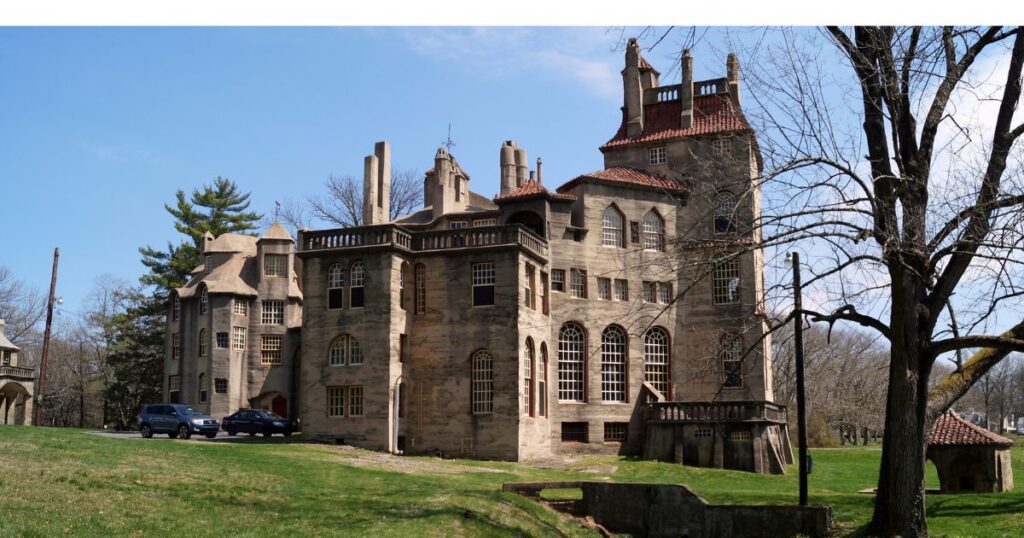
- Fonthill Castle – imaginative towers, turrets, and sweeping concrete forms.
Gilded Age Palatial Styles
Symmetry, European influences, elaborate craftsmanship, and extensive gardens.
Examples:
- Grey Towers – French chateau inspirations.
- Cairnwood Estate – Beaux-Arts refinement.
Georgian / Colonial Grandeur
Strong profiles, stone construction, and stately façades with historic detailing.
Example:
- Mount Pleasant Mansion – an 18th-century estate with a bold presence.
Where to Find Castles In Pennsylvania
Southeastern Pennsylvania
Home to Glencairn Museum, Cairnwood Estate, Mount Pleasant, and several historic stone mansions.
Doylestown & Central Bucks County
A center of arts-and-crafts history, including Henry Mercer’s Fonthill Castle.
Northeastern Pennsylvania (Poconos & Milford)
Scenic landscapes surround Grey Towers and other historic estates.
Western Pennsylvania
Includes the castle-style Chateau Lafayette and additional grand resort architecture.
To explore castle regions across the United States, see my full overview of Castles in America. And if you’re mainly exploring castle-style architecture in neighboring states, you may enjoy my guide to Castles in New York, featuring Gothic Revival mansions, island estates, and Gilded Age landmarks.
Top Castles to Visit in Pennsylvania
Fonthill Castle
A handcrafted medieval-inspired masterpiece. Built between 1908–1912 by Henry Chapman Mercer, Fonthill Castle is an imaginative blend of medieval, Gothic, Romanesque, and arts-and-crafts influences—all executed in reinforced concrete. Inside, handcrafted tiles, decorative motifs, towers, and vaulted spaces create an unforgettable environment. Guided tours offer insight into Mercer’s life, creativity, and architectural innovation.
Glencairn Museum
A soaring Gothic Revival tower rich with craftsmanship. Once a private home, Glencairn Museum was designed with medieval inspiration, featuring carved stone, stained glass, symbolic motifs, and a dramatic central tower. Its architecture alone is worth the visit, while its collections highlight religious art and craftsmanship from around the world.

Grey Towers National Historic Site
A Gilded Age estate with French chateau character. Commissioned by conservation pioneer Gifford Pinchot, Grey Towers pairs elegant stone towers with terraced gardens, reflecting pools, and a picturesque forest setting. The site blends European design with American landscape tradition, offering both architectural and historical appeal.
Eastern State Penitentiary
A fortress-like landmark with global influence. Resembling a massive stone castle, Eastern State Penitentiary introduced a radical radial design that influenced prisons worldwide. Its Gothic-style towers and heavy stone walls create a dramatic presence, while tours and exhibits reveal centuries of architectural, social, and cultural history.
Cairnwood Estate
A Beaux-Arts mansion with castle-like elegance. Part of the Bryn Athyn Historic District, Cairnwood Estate features steep gables, stone arches, artistic detailing, and landscaped grounds. The mansion’s architecture blends opulence with medieval inspiration, offering tours, cultural events, and seasonal programs.
Chateau Lafayette (Nemacolin Resort)
A grand chateau experience in Pennsylvania’s Laurel Highlands. Inspired by French Renaissance palace architecture, Chateau Lafayette offers a castle-style atmosphere with symmetrical façades, stonework, formal gardens, and richly decorated interiors. It also serves as a luxury resort destination.
Mount Pleasant Mansion
A stately Georgian stone estate with historic significance. Located in Philadelphia’s Fairmount Park, Mount Pleasant was built in 1761 and exudes a commanding presence with its stone façade and strong architectural lines. Its history includes merchants, ship captains, and Revolutionary-era figures, making it both architecturally and culturally notable.
Bube’s Brewery Mansion & Victorian Complex
A unique and atmospheric castle-like landmark. This Lancaster County attraction includes a Victorian mansion with stonework, towers, and decorative elements that echo castle aesthetics. The broader complex includes preserved brewery cellars, historic architecture, and immersive visitor experiences.
If you’re exploring castle-style architecture beyond Pennsylvania, you might also enjoy my full guide to Castles in America, featuring the most fascinating castle-inspired landmarks across the country.
Other Noteworthy Castles In Pennsylvania
- Linden Hall Estate – Towered historic mansion with strong architectural presence.
- Harry Packer Mansion – Gothic Victorian favorite in Jim Thorpe.
- Moravian Pottery & Tile Works – Not a castle, but visually linked to Mercer’s architectural legacy.
- The Castle Inn, Delaware Water Gap – Castle-like historic inn with period charm.
If you’re exploring castle destinations in the western U.S., you may enjoy my guide to Castles in California.
Castle Gardens & Landscapes in Pennsylvania
Pennsylvania’s castle-style buildings sit within landscapes that enhance their beauty and context. Grey Towers offers formal gardens, terraces, and forested walking paths. Cairnwood’s gently sloped lawns and woodland edges complement its architecture. Fonthill Castle’s grounds incorporate Mercer’s artistic sensibilities with naturalistic surroundings.
Even Eastern State Penitentiary, despite its fortress-like character, provides atmospheric outdoor spaces framed by weathered stone and dramatic light.
Castle Restoration & Preservation in Pennsylvania
Preservation efforts reflect the significance of the state’s castle-style landmarks:
- Grey Towers is maintained by the U.S. Forest Service with ongoing conservation projects.
- Fonthill Castle and the Tile Works are managed by the Bucks County Historical Society.
- Glencairn Museum continues careful restoration as both a museum and architectural treasure.
- Eastern State Penitentiary uses stabilized-ruin methods to preserve its atmospheric corridors and imposing stone structure.
- Cairnwood Estate undergoes continuous maintenance to support cultural programs and events.
These efforts ensure public access while preserving architectural integrity.
Notable Figures & Events
Henry Chapman Mercer (1856–1930)
An archaeologist, historian, and tilemaker, Mercer was a leading figure in the American Arts and Crafts Movement. His interests in medieval craft traditions shaped the construction of Fonthill Castle and the Moravian Pottery & Tile Works. His influence helped preserve handcraftsmanship at a time when industrialization dominated America.
Raymond & Mildred Pitcairn
Key figures behind Glencairn Museum and the Bryn Athyn Historic District, the Pitcairn family oversaw the creation of some of the most artistically ambitious architecture in the state. Their dedication to craftsmanship, symbolism, and sacred art shaped Glencairn’s distinctive Gothic Revival style.
Gifford Pinchot (1865–1946)
America’s first Chief of the U.S. Forest Service and a two-time Pennsylvania governor, Pinchot lived at Grey Towers. His conservation leadership helped establish America’s approach to forest management and environmental policy. Grey Towers was later designated a National Historic Site due to his national significance.
The American Conservation Movement
Grey Towers is deeply tied to the birth of conservation in the United States. Landmark decisions, forestry policies, and early ecological ideas were developed here, making the estate a hub of environmental history.
The Bryn Athyn Cathedral Construction Era (1913–1919)
Glencairn Museum is part of a unique historic district created during a period of intense artistic collaboration. Stonemasons, sculptors, and stained-glass artisans worked side-by-side, leaving behind an unparalleled example of American Gothic craftsmanship.
Colonial & Revolutionary-Era Figures at Mount Pleasant Mansion
Mount Pleasant was built for John Macpherson, a privateer whose wealth came from maritime trade. Later, the estate was purchased by Benedict Arnold as a wedding gift for his wife, Peggy Shippen – a figure tied to one of the most notorious espionage events in American history. The estate reflects Philadelphia’s role in colonial commerce and Revolutionary intrigue.
Industrialization & the Gilded Age
Many Pennsylvania estates – including Cairnwood and parts of the Bryn Athyn district – were built by families shaped by the era’s industrial success. Their architectural commissions brought craftsmanship, design, and luxury to the region at a scale that rivaled New York and New England estates.
Castles in Modern Pennsylvania Culture
Pennsylvania’s castles appear in films, documentaries, photography, and cultural events.
- Eastern State Penitentiary is featured in movies, ghost tours, and seasonal events.
- Glencairn Museum hosts art exhibitions, religious-themed displays, and cultural programs.
- Fonthill Castle offers artisan-focused events and tours.
- Chateau Lafayette is a popular wedding and luxury travel destination.
These sites blend historic preservation with modern cultural engagement.
Cultural Traditions Linked to Pennsylvania Castles
Seasonal traditions bring these architectural sites to life:
- Holiday celebrations at Glencairn and Fonthill
- Fall foliage tours at Grey Towers
- Art and craft demonstrations inspired by Mercer
- Evening tours and special programs at Eastern State
These programs enrich the visitor experience and connect communities to their architectural heritage.
Looking for more American castles? Explore my guide to Castles in North Carolina, including Biltmore – one of the most famous estates in the country.
Planning Your Castle Tour in Pennsylvania
Planning a castle-themed trip in Pennsylvania varies depending on the region you choose. Southeastern Pennsylvania offers the highest concentration of castle-style architecture, with Glencairn Museum, Cairnwood Estate, and Eastern State Penitentiary located within an hour of Philadelphia. This makes it easy to plan a full-day or weekend itinerary focused on Gothic Revival design, museum collections, and historic urban architecture.
If your travels take you toward the Delaware River Valley, Fonthill Castle provides a rewarding deep dive into the Arts and Crafts Movement. Visitors often pair it with the nearby Moravian Pottery & Tile Works, which expands the understanding of Henry Mercer’s life and craftsmanship.
Grey Towers, located in the Pocono foothills, requires more planning due to its rural setting and seasonal hours. The estate is ideal for travelers seeking scenic landscapes, conservation history, and quieter touring environments. The area is particularly beautiful during fall foliage season, but tours operate on limited schedules, so advance planning is essential.
Across the state, many historic estates operate with guided-only tours, limited capacity, and seasonal closures. Parking can vary widely – from urban neighborhoods to rural gravel lots – so checking each site’s visitor information ahead of time will help ensure smooth logistics.
Best time to visit: Late spring through fall, when museums and garden tours are fully operating.
Allow time: Most sites take 60–90 minutes; Grey Towers and Fonthill may require two hours or more depending on tour availability.
Suggested clusters:
- Bryn Athyn Historic District: Glencairn Museum + Cairnwood Estate
- Philadelphia Area: Mount Pleasant + Eastern State Penitentiary
- Doylestown: Fonthill Castle + Moravian Tile Works
- Poconos: Grey Towers + Milford’s historic district
Practical Tips For Visiting Castles In Pennsylvania
Pennsylvania’s castle-style sites span diverse landscapes and architectural eras. Preparing in advance ensures a comfortable and rewarding visit.
Trip Planning Essentials
Regions to consider:
Philadelphia’s historic estates; Doylestown’s arts-and-crafts landmarks; the Poconos for Grey Towers; western Pennsylvania for castle-style resort architecture.
Getting around:
A car is the most practical option. Urban sites may be accessible by transit or rideshare, while rural estates require driving.
When to visit:
Spring and fall offer the most pleasant weather. Summer is busiest, and winter hours vary significantly.
Book ahead:
Tours at Fonthill, Glencairn, and Grey Towers often fill quickly. Seasonal programs and special exhibits may require reservations.
On-Site Advice & Insider Insights
Terrain:
Expect a mix of paved paths, stairs, garden walks, and uneven ground—especially at historic or ruin-like sites.
Weather:
Pennsylvania’s weather can shift quickly. Bring layers, comfortable shoes, and weather protection.
Photography:
Fonthill’s handcrafted interiors, Glencairn’s tower views, and Grey Towers’ terraces all offer excellent photography opportunities.
Accessibility:
Some castle-style sites have limited elevator access; check details before your visit. Glencairn and Fonthill offer partial accommodations.
Great for kids:
Eastern State’s massive corridors and Mercer’s tile-lined interiors often fascinate older children.
Seasonal highlights:
Grey Towers in autumn; Glencairn’s Christmas programs; Fonthill’s summer events.
Facilities:
Many sites offer restrooms, visitor centers, or small cafés. Rural estates may have fewer facilities—plan accordingly.
Frequently Asked Questions About Castles In Pennsylvania
Are there real castles in Pennsylvania?
Yes—Pennsylvania has numerous castle-style buildings, including Gothic mansions, fortress-style structures, and handcrafted estates.
Which Pennsylvania castle is the most famous?
Fonthill Castle and Eastern State Penitentiary draw the most visitors each year.
Can you stay overnight in a Pennsylvania castle?
Chateau Lafayette offers luxury resort accommodations.
Are Pennsylvania castles open year-round?
Many operate throughout the year, though winter hours may be limited.
Are any of these castles medieval?
No—Pennsylvania’s castles were built between the 18th and early 20th centuries and were inspired by European design traditions.
Conclusion
Pennsylvania’s castles reveal an extraordinary blend of artistry, ambition, history, and architectural imagination. From Gothic towers to handcrafted interiors, fortress-like structures, and elegant Gilded Age estates, each site offers a unique window into the state’s cultural and architectural heritage.
Whether you’re exploring museum collections, strolling landscaped grounds, or photographing dramatic façades, these castle-style landmarks provide unforgettable experiences for travelers, architecture lovers, and history enthusiasts alike.
Pennsylvania’s castles are just one chapter in America’s surprising architectural story. To discover castle-style landmarks in other states, take a look at my complete guide to Castles in America.
Image Credits
Glencairn Museum, Pennsylvania
Great Room at Glencairn Museum, photo by Bestbudbrian, via Wikimedia Commons, licensed under CC BY-SA 4.0 (https://creativecommons.org/licenses/by-sa/4.0/).
Grey Towers, Pennsylvania
Grey Towers front façade, photo by Beyond My Ken, via Wikimedia Commons, licensed under CC BY-SA 4.0 (https://creativecommons.org/licenses/by-sa/4.0/).
Mount Pleasant Mansion, Pennsylvania
Mount Pleasant Mansion, photo by ProfReader, via Wikimedia Commons, licensed under CC BY-SA 3.0 (https://creativecommons.org/licenses/by-sa/3.0/).