Hohenzollern Castle Guide: History, Highlights & How to Visit

Perched high above the Swabian Alps, Hohenzollern Castle is one of Germany’s most dramatic and photogenic fortresses. Home to the dynasty that produced Prussian kings and German emperors, the castle you see today is a 19th-century reconstruction that blends medieval atmosphere with romantic architecture and royal history.
Whether you’re visiting for the sweeping mountain views, its Prussian crown jewels, or the fairy-tale silhouette, this guide covers everything you need to know – from what to see inside to how to get there and the best time to visit.
This guide draws on my 40+ years in the travel industry and decades of exploring Europe’s historic sites – including many personal visits to castles around Europe, the UK. and Ireland. I’ve updated this post to give travelers clear, reliable, and easy-to-use information when planning a visit.
Historical Snapshot
- Location: Baden-Württemberg, Germany
- Founded: 11th century (current castle built 1846–1867)
- Founded by: House of Hohenzollern
- Architectural Style: Neo-Gothic revival
- Famous For: Prussian crown jewels, panoramic mountain views, fairy-tale silhouette
- Claim to Fame: Ancestral seat of the dynasty that ruled Prussia & later the German Empire
Planning a broader trip through the region?
Explore more historic sites on our German Castles Page.
Table of Contents
Historical Overview

The history of Hohenzollern Castle spans nearly 1,000 years, marked by three major construction phases and centuries of political influence tied to the Hohenzollern dynasty.
If you’re interested in exploring more historic fortresses across the country, visit our full Castles in Germany Guide.
1. The First Castle (11th Century)
Built around 1060, the original fortress served as the family seat of the Hohenzollerns. Medieval chroniclers described it as one of the strongest fortifications in southern Germany.
2. The Second Castle (1454–1461)
After a siege destroyed the first stronghold, a second – even larger – castle was constructed. This version was a major military installation and stood for centuries, though it eventually fell into disrepair after losing strategic importance.
3. The Third Castle (1846–1867)
The castle seen today was commissioned by King Frederick William IV of Prussia, who envisioned a romantic, idealized family castle. Designed by Friedrich August Stüler, it reflects 19th-century enthusiasm for medieval revival architecture.
Today, the fortress remains privately owned by the Hohenzollern family, with Prince Georg Friedrich of Prussia as its current head.
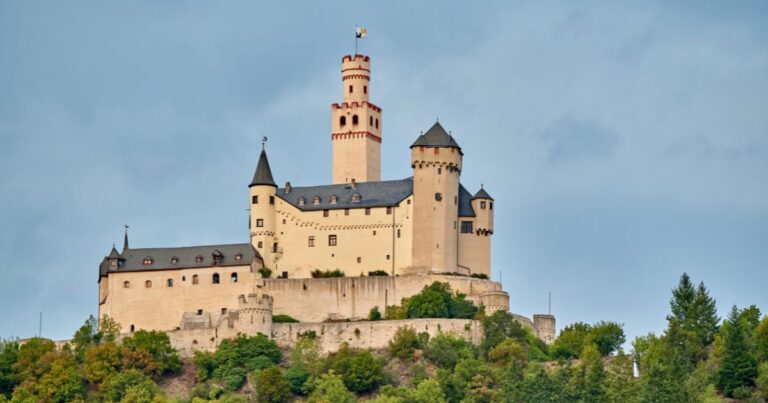
If you’re interested in exploring more of Germany’s remarkably preserved fortresses, Marksburg Castle offers one of the most authentic medieval castle experiences in the country – the only hilltop stronghold never destroyed.
Architectural and Design Highlights
Hohenzollern Castle blends romantic neo-Gothic styling with medieval fortress engineering to create one of Germany’s most dramatic hilltop castles.
The Eagle Gate
Forming the main entry to the castle complex, the Eagle Gate is marked by twin towers, a raised drawbridge, and richly detailed stonework. Many visitors pause here to take in the full sweep of the mountaintop panorama before entering.
Zwinger Walls & Ramparts
The zwinger, or outer defensive courtyard, wraps around the hillside with multiple levels of ramparts and bastions. Walking along these paths offers both an immersive sense of its defensive past and unbeatable views of the Swabian Alb.
Towers & Turrets
Four main towers sit above the bastions — each aligned with a different section of the castle. Look for the Emperor’s Tower, Bishop’s Tower, and Margrave’s Tower, each crowned with distinctive spires and decorative stonework.
Chapel Complex
Two chapels stand at the heart of the castle’s residential wing: the Protestant Christ Chapel and the Catholic St. Michael’s Chapel. Both feature stained glass, royal memorials, and richly carved architectural elements. Their placement side-by-side reflects the later branch split of the Hohenzollern family.
Courtyards & Bastions
Inside the main gate lies a series of terraced courtyards leading to the palatial wings. Below these are the far older bastions, once dedicated to artillery and defense, now offering visitor routes and historic insight.
Palatial Wings
Unlike purely defensive castles, Hohenzollern’s 19th-century reconstruction integrates elegant residential wings. These include richly decorated facades, carved balconies, coats of arms, and a U-shaped layout that encloses the inner courtyard — a nod to châteaux of the Loire and English Gothic Revival.
For a very different look at Prussian architecture and royal life, Sanssouci Palace showcases Frederick the Great’s intimate Rococo retreat – a peaceful palace filled with art, philosophy, and elegant design.
Inside Hohenzollern Castle: What You’ll See
Once past the ramparts and gates, Hohenzollern Castle transforms from fortress into palace – still imposing, but now layered with history and grandeur.
Royal Apartments & State Rooms
The restored apartments of the Hohenzollern dynasty include the Count’s Hall with its ribbed vaulting, stained-glass windows, and red marble columns. Adjoining salons feature portraits of Prussian kings, opulent furnishings, and richly carved mahogany paneling — a sharp contrast to the fortress exterior.
The Treasury & Crown Jewels
Hohenzollern’s treasury ranks among the finest in Germany. Center stage sits the Prussian royal crown made for Kaiser Wilhelm II, surrounded by ceremonial swords, medals, and silverwork. Visitors can step into the treasury room and view these items in glass display cases under low lighting — one of the highlights of any tour.
Armory & Royal Regalia
Walking beyond the treasury, you’ll find an armory exhibit showcasing uniforms of the Prussian army, weapons spanning from the 18th to 19th centuries, and banners that reflect the shifting roles of the Hohenzollern family in European politics. These displays reinforce how the castle was both a seat of power and a symbol of royalty.
Casemates, Storage Vaults & Defensive Passages
Beneath the grand halls lie the older layers of the site – casemates, storage vaults, and defensive passages that pre-date the palatial wings. These rooms carry echoes of sieges, military planning, and centuries of structural evolution. While not all are open to the public, the accessible sections invite visitors to lean into the castle’s defensive origins.
Panorama & Roof Walks
Several towers have accessible upper platforms and galleries. After touring the interiors, many visitors climb to these vantage points for sweeping views. The contrast between detailed interior ornamentation and the open-air battlements reinforces the castle’s dual nature: residence and fortress.
Notable Figures and Events
These are some historically notable figures and events tied to Hohenzollern Castle:
- Frederick William IV of Prussia
Commissioned the current neo-Gothic reconstruction in the 19th century. - Frederick the Great (Frederick II)
Though he never resided here, artifacts connected to him – including uniforms and personal items – are housed in the treasury. - Kaiser Wilhelm II
Germany’s last emperor; several items connected to his reign are displayed inside. - Two Historic Sieges (1423 & 1454)
Both significantly shaped the castle’s medieval evolution. - World War II Era
The castle served various functions, including storage of important cultural artifacts.
Legendary Tales and Local Lore
Like many historic fortresses, Hohenzollern Castle has its share of traditional stories and local legends – tales passed down over centuries that add atmosphere to the site’s long history. While these accounts are part of regional folklore rather than documented events, they remain a memorable part of the castle’s cultural identity.
The Black Knight
One of the best-known legends speaks of a phantom knight said to watch over the castle in times of danger. According to tradition, sightings of the “Black Knight” were considered a sign of protection for the Hohenzollern family. While purely a tale, it remains a popular part of the castle’s lore.
The White Lady
Another long-standing story involves a noblewoman whose tragic fate supposedly ties her spirit to the castle. Known as the “White Lady,” she is said to appear in white garments – a common motif in European castle folklore. Variations of this tale appear throughout German-speaking regions and have become woven into Hohenzollern’s narrative as well.
Echoes in the Halls
Visitors over the years have described unexplained sounds or sensations, often attributed to the legends that surround the castle. These accounts are part of the site’s folklore tradition and contribute to the castle’s reputation for atmosphere and mystery – especially during evening tours.
Why Visit Hohenzollern Castle
Hohenzollern Castle is one of Germany’s most iconic hilltop fortresses – and one of the most accessible day trips from Stuttgart, Tübingen, or even Lake Constance. The combination of royal interiors, atmospheric courtyards, and expansive views from 855 meters above sea level makes it feel like something lifted straight from a storybook.
Visitors love it because:
- The treasury houses the actual Prussian royal crown
- The Count’s Hall and royal apartments are stunning and photogenic
- Its mountaintop setting offers some of the best castle views in Germany
- The casemates and fortifications show its military origins
- Guided tours provide rich history in an easy-to-digest way
It’s a perfect blend of history, scenery, and royal heritag
Visiting Hohenzollern Castle Today: What To Expect
A visit to Hohenzollern Castle combines history, scenery, and a bit of adventure thanks to its mountaintop location. Here’s what you can expect during your visit:
Holiday Events: Seasonal events, light displays, and Christmas markets may alter opening hours or crowd levels.taged, but the outdoor terraces and views often end up being the highlight for visitors.
Uphill Walk: Even with the shuttle from the parking area, the final approach to the Eagle Gate includes an uphill climb. Comfortable shoes are highly recommended.
Photography Rules: Outdoor photography is allowed throughout the courtyards and ramparts. Interior photography rules vary by season and tour type, so check signage or ask upon entry.
Weather Changes Quickly: Because the castle sits at 855 meters (2,805 ft), fog, wind, or sudden temperature changes are common. Clear days offer spectacular views, especially at sunset.
Tours & Audio Guides: The castle offers both guided tours and self-guided audio options. Availability depends on the season and visitor volume.
Crowds: Hohenzollern Castle is popular year-round. Mornings and late afternoons typically offer a quieter experience.
Getting There
By Car
- About 1 hour from Stuttgart.
- Parking is located at the base of the mountain.
- A shuttle runs seasonally between the parking area and the castle entrance path.
By Train + Shuttle
- Take the train to Hechingen.
- From the station, a dedicated shuttle operates to the castle parking area.
- The final portion to the Eagle Gate may still require an uphill walk.
Driving Tips
- The access road is well-maintained year-round.
- Arriving early helps secure parking on busy weekends and holidays.
Visitor Information
Hours, ticket details, and seasonal schedules can change – be sure to double-check the official website before planning your visit.
Hours
- Hours vary by season (winter vs. summer schedules).
- The castle is generally open daily.
- Holiday schedules may differ.
Admission
- Separate tickets for castle grounds and interior rooms.
- Discounts available for children and families.
- Guided tour prices may vary by season.
Accessibility
- Steep paths leading to the castle may be difficult for some visitors.
- Due to the historic structure, several areas have limited mobility access.
- Shuttle options help reduce uphill walking but do not eliminate all steps.
Nearby Attractions
- Hechingen – a charming town with local cafés and shops
- Burg Hohenzollern Panorama Walks – scenic hiking paths around the mountain
- Stuttgart – major city with museums, palaces, and gardens
- Tübingen – a picturesque university town perfect for a half-day trip
Frequently Asked Questions About Hohenzollern Castle
How long do you need to visit Hohenzollern Castle?
Most visitors spend 2–3 hours exploring the courtyards, interiors, ramparts, and viewpoints. Allow extra time if you’re visiting during peak season or want to take a guided tour.
Are guided tours available inside Hohenzollern Castle?
Yes. The castle offers guided tours (often in German with audio guides in multiple languages) that take you through the royal apartments, chapel, and treasury. Check the official website for current times and availability.
Is Hohenzollern Castle accessible for people with mobility issues?
Access can be challenging due to steep paths, cobblestones, and historic architecture. Shuttle buses reduce uphill walking, but the interior rooms still require navigating stairs.
Can you take photos inside Hohenzollern Castle?
Photography is typically allowed outdoors and in the courtyards, but interior rooms may have restrictions. Always check posted signage or ask staff upon arrival.
What is the best time to visit Hohenzollern Castle?
Mornings and weekdays are the least crowded. Clear days provide spectacular views across the Swabian Alps, while autumn foliage and winter snow give the castle a dramatic seasonal atmosphere.
How do you get to Hohenzollern Castle without a car?
Visitors can take the train to Hechingen, then transfer to a shuttle bus or taxi that brings you to the castle entrance area. From there, shuttle buses or a steep 20-minute walk lead up to the castle.
Conclusion
Hohenzollern Castle is one of Germany’s most atmospheric and rewarding castle visits – a perfect blend of romantic architecture, imperial history, and breathtaking alpine scenery. Whether you come for the treasury, the royal apartments, or the panoramic ramparts, it’s a destination that offers depth, beauty, and unforgettable views.
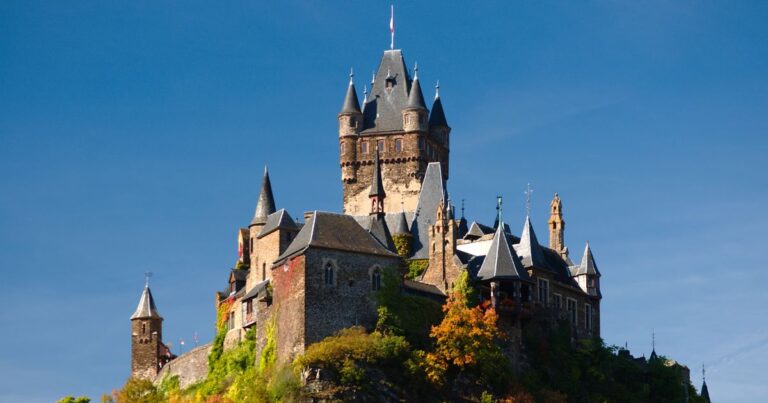
For another dramatically perched castle with unforgettable views, Cochem Castle is a wonderful addition to a Germany itinerary.
If you’re planning a broader trip through Germany’s royal landmarks, Marksburg Castle and Sanssouci Palace both offer exceptional experiences that complement a visit to Hohenzollern.